Projects & Impact
Documented work and what we learn from it
These cases distinguish observation, documentation, learning resources and proposed design. Measured impact requires a baseline, an indicator and follow-up; photos and media reports document activities, but alone do not measure changes in people’s lives.
Umm Al-Jimal: from water heritage to a learning question
Status: published field documentation and available learning resources.
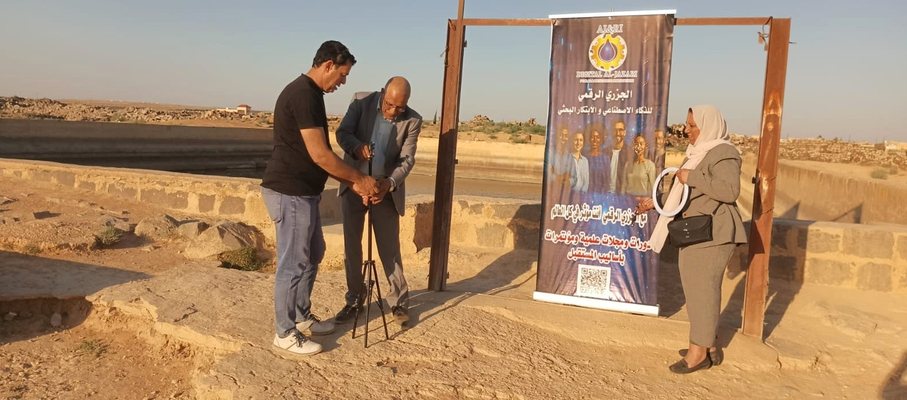
Need: understand how water collection, flow and storage connect with community life in a dry environment. Documented work: team visits and photography of reservoirs and basalt architecture; reported by Ammon on 11 June 2026 and Al-Anbat on 13 June 2026.
Ammon report · Al-Anbat report
Try now: map a question
- Draw three boxes: water source → flow path → storage. Add what you observe or read; leave unknowns as questions.
- Distinguish “the photo shows a structure” from “the structure proves sufficient water.” The second requires measurement.
- Try a learning scenario and check the units before interpreting the result.
Deir Al-Kahf: observation before design
Status: field observation and measurement; ecosystem restoration remains a proposed design.
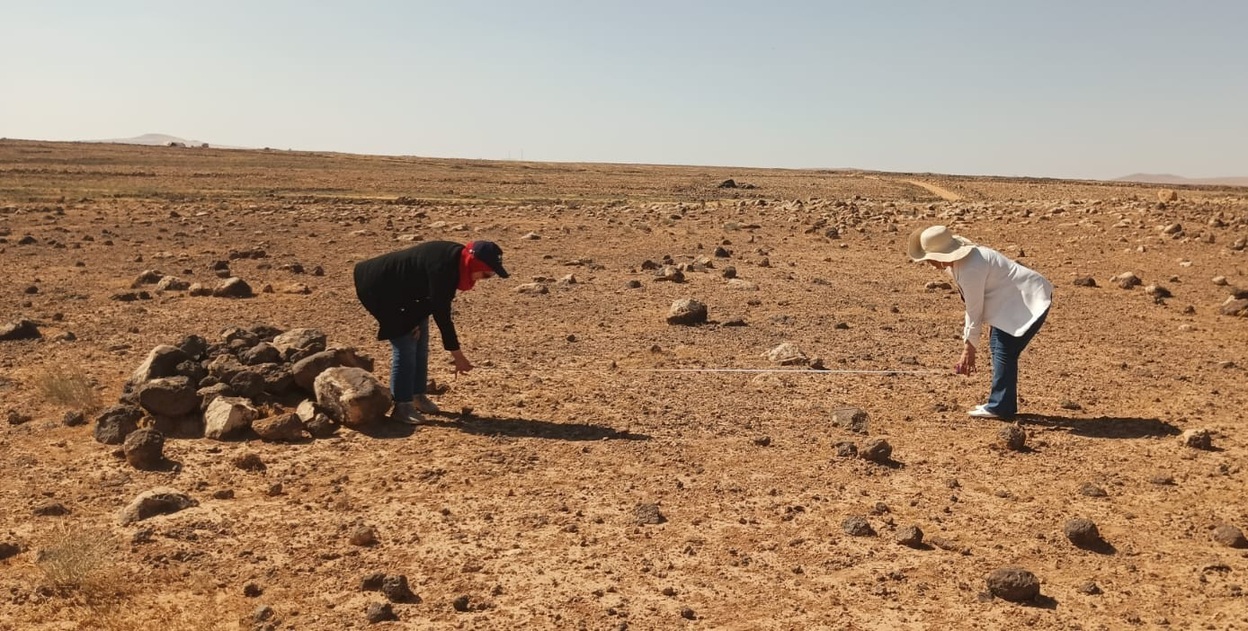
Need: examine links between rainwater harvesting, soil and vegetation in the northern Badia. The photograph documents measurement; institutional records describe a modern trial design inspired by Umm Al-Jimal. The file does not establish construction of an integrated system or achieved ecological outcomes.
Try now: an observation record
Record: general location — observation — measurement method and unit — missing information — who reviews the interpretation. Learning example: “A distance between two points, in metres, is insufficient to establish slope or runoff; elevations, rainfall data and specialist review are needed.” Do not enter an unsafe site for this exercise.
Education and local knowledge: from question to worksheet
Status: published Arabic and English learning resources.
Human-Centered AI provides guides, exercises and learning labs, while ANAwAI offers responsible-use resources. Practical example: turn a circulating water claim into a checkable question, then record a source and the limits of the inference. No family names or children’s personal data are needed.
How do you start an initiative connecting knowledge with community need?
Start with a small task people can choose to join. Listen before proposing a tool; offer a paper alternative; name a reviewer and an indicator before the trial.
Worked example — a learning design, not an implemented project
Need: help a group of families check a claim about water use. Output: one verification card with a source. Resources: paper, a facilitator and a public source. Participation: voluntary, without names or photos. Indicator: can each participant explain why a claim was accepted or rejected? Review: a teacher or specialist; stop if personal data or an unsafe recommendation appears.
A local sheet; do not enter names or sensitive information. Inputs disappear when you leave the page.
Completed example and paper alternative
- Specific need
- Check a circulating claim about water use
- Small output
- A verification card with a public source
- Available resources
- Paper, a facilitator and an accessible source
- Participation and privacy
- Voluntary participation; no names or photos
- Reviewer and responsibility
- A teacher checks the claim and source; stops unsafe advice
- Benefit indicator and how to check it
- Explain why a claim is accepted or rejected; compare explanations before and after the session
Write the six fields on paper, then review them before sharing or implementation.
How do you read evidence before relying on a result?
- State the claim precisely: an activity, an outcome or a generalisation?
- Open the original source and check its date and evidence method.
- Ask what the evidence does not establish and what requires measurement or comparison.
Worked example: “a team photo beside a reservoir” records a visit in that context; it does not establish water savings or increased income. “A press report” documents what the outlet published; it does not replace an independent evaluation.
Text explanation — available without JavaScript
- A team photo near a water structure — Documentation of a visit in the photo’s context. A photo records what is visible; it does not measure water or vegetation.
- A press report about a visit — Documentation of what the outlet published about the visit. A report is a media record; impact measurement needs data and an evaluation method.
- A 40% task-time difference using invented data — Explanation of calculation in a learning example. Invented data explain a calculation, not a field outcome.
A Message from Aqaba to the Future
Young people in Aqaba produced a short video message about climate and the future using their mobile phones, published on the Climate & Population platform.